How do bilingual churches work? Five models, not one
When people ask how do bilingual churches work, they usually expect a single answer: someone translates the sermon. In practice there are at least five distinct operating models, and they differ enormously in cost, staffing, and how much of the congregation actually stays together.
A pastor writing for Lifeway Research identifies three delivery methods for bilingual worship alone: live translation from the platform, translators transmitting to headphones, and apps that interpret simultaneously into another language. Add two structural models — fully duplicated services and the "one church, two languages" approach — and you have the full map.
This guide walks through all five, shows how common each is with actual survey numbers, and — most usefully — covers what practitioners report breaking after a decade of doing it. That last part is where most articles on this topic go quiet.
The five models, and what each one actually demands
Pick the model that matches your staffing reality, not the one that sounds most unified.
1. Alternating from the platform
The speaker says a sentence or a paragraph; an interpreter beside them repeats it in the second language. Everything happens out loud, for everyone, from the stage.
Strengths: zero hardware, zero channel management, and total visibility — nobody is a guest at someone else's service. Costs: your service length roughly doubles for the translated portions, and both language groups sit through content they don't understand. The Lifeway author notes churches lose members who find this confusing or simply grow weary of worshiping outside their comfort zone.
2. Interpreters on headsets
An interpreter works from a booth or back row into a transmitter; attendees who need the second language wear receivers. Service length stays normal and the primary-language experience is untouched.
This is the classic conference model applied to church. It's channel-based: an interpreter console paired with an FM assistive listening system can carry multiple language channels from multiple interpreters at once, and in U.S. houses of worship the gear should be FCC-approved for translation and assistive listening. The real constraint is people — you need a reliable interpreter for every language, every week.
3. App-based live interpretation
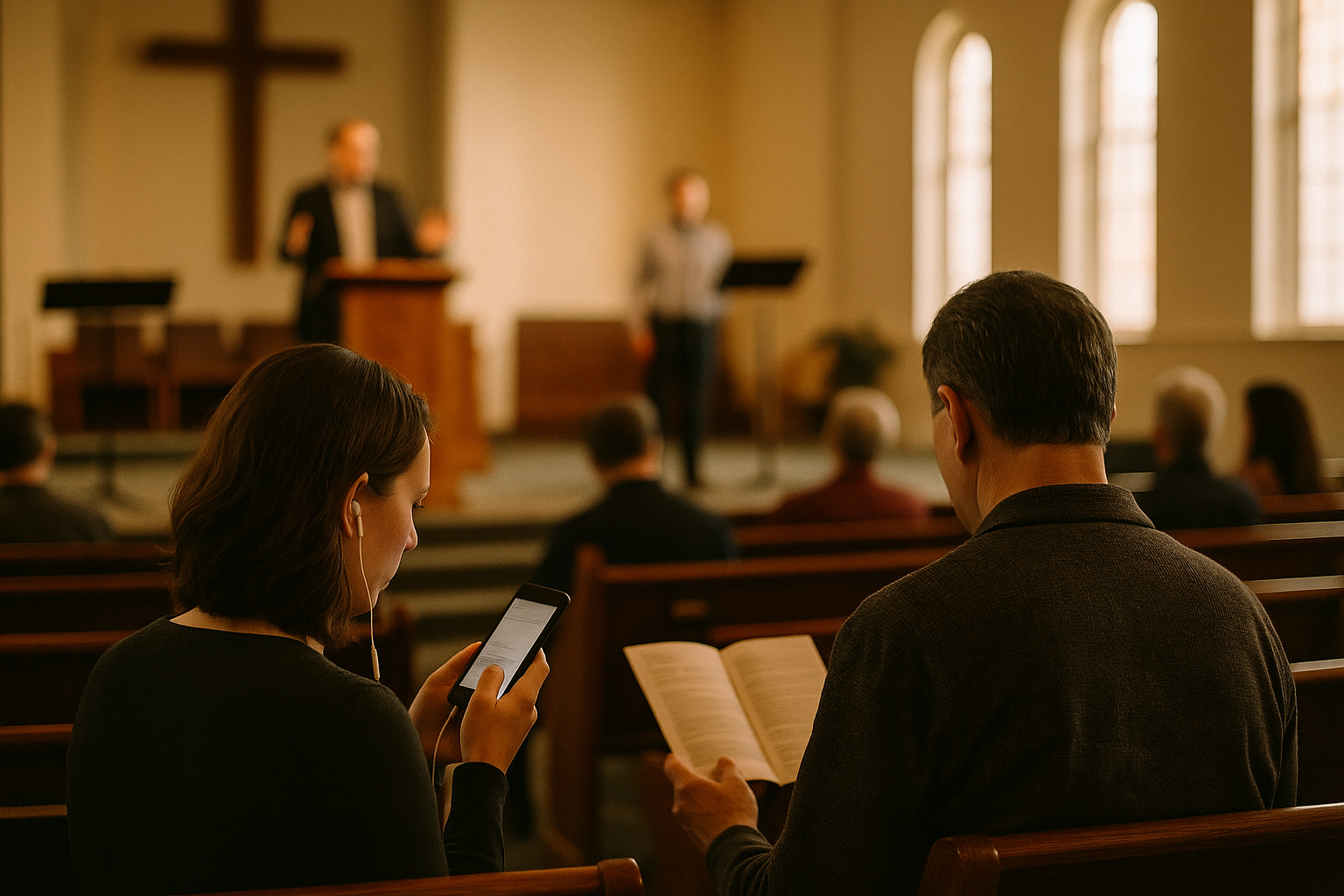
Instead of distributing receivers, you send the audio to attendees' own phones. They open a link, choose a language, and listen through their earbuds. This is the model TransLync is built for: one feed from your sound board, several languages out, no receiver inventory to charge, sanitize, and chase down after the service.
The honest tradeoff: it depends on phone batteries, decent connectivity, and a congregation comfortable enough with technology to open a link. Lifeway's reporting is blunt that translation technology performs better in larger churches, for two reasons — bigger churches have sound or media directors who keep it working, and their attendees tend to be more comfortable with the tech. Smaller churches more often struggle to operate and maintain equipment.
4. Full duplication: parallel services
Vertical Church/Iglesia Vertical runs three Spanish services and two English ones, duplicating worship slides, marketing, and small-group curriculum so both sides get, in their words, the "same exact experience, worship, preaching, announcements. Same vision" (The Art of Leadership).
This is the highest-fidelity option for each language group and the highest workload for staff. It also requires deliberate guarding against bias — down to choosing worship songs and sermon series titles that work in both languages, so neither congregation feels like the secondary one.
5. "One church, two languages"
Evergreen Bible Church has run this way since 2008 and explicitly distinguishes it from the far more common arrangement where a separate ethnic congregation simply uses another church's building. Shared budget, shared leadership, shared membership — different language services.
That distinction matters, because the label gets used loosely. One pastor writing at Rambling Ever On observes that churches calling themselves bilingual are frequently English-speaking congregations with a separate Spanish ministry, or two churches sharing grounds. True bilingual operation extends past Sunday: the same source describes translating everything, including print materials and social media — and admits that even after 10 years, leaders still occasionally forget and post in only one language.
How common is this, actually?
Among Hispanic Protestant churches overall, 18% lead all-bilingual services, 69% hold services primarily in Spanish, 12% run separate Spanish, English, and/or bilingual services, and 2% worship entirely in English (Lifeway Research).
New church works look similar: 65% Spanish-only, 20% bilingual, 12% running separate services, 4% all English, per a Lifeway survey of 292 Hispanic new church works conducted September–November 2025.
The more revealing number is what the non-bilingual churches offer. Among new church works that aren't bilingual, 72% provide no translation at all. Just 23% offer translation into English via headset or in part of the room, and 4% offer similar translation into Spanish. Meanwhile 18% plan to move from all-Spanish to bilingual or add English translation within the next year.
So if you're weighing this decision, you're in a large group that hasn't solved it yet — and the churches that have solved it mostly did so with headsets.
Why churches go bilingual: it's generational, not geographic
The pressure rarely comes from a changing neighborhood. It comes from inside the family.
A bilingual church pastor interviewed by SmallGroups.com describes second- and third-generation young people leaving Spanish-only churches because they don't speak Spanish or no longer prefer it — Spanish-only ministry, in his framing, reaches only the first generation. Pew Research Center data backs the generational split: foreign-born Hispanics are far more likely than U.S.-born Hispanics to prefer Hispanic clergy (31% vs. 8%) and a mostly Hispanic congregation (26% vs. 6%).
The same dynamic runs through Korean, Chinese, and other immigrant congregations, where different generations in one church speak different primary languages — which makes bilingual worship necessary if the church wants to worship as one family (APCE). That source also notes bilingual worship is not a modern invention: Acts 6, where deacons are appointed to serve Greek-speaking widows, is the scriptural precedent.
And the traffic runs both ways. Lifeway Recursos' director of global publishing reports seeing "more and more English-speaking churches either planting a Hispanic church or adding a service in Spanish."
What breaks (the part nobody warns you about)
Three findings from churches with a decade or more of experience:
- Bilingual small groups don't work. The church interviewed by SmallGroups.com tried them and stopped, for three reasons: not everyone can self-translate, not every small-group leader can translate, and mid-conversation translation is awkward — especially when someone is sharing something emotional. Sunday translation and midweek translation are different problems.
- You will lose people. Over 15 years, the Lifeway author's church lost both English and Spanish speakers who disliked bilingual services or found them confusing. Plan for that instead of being surprised by it.
- There is no template to copy. In 15 years leading bilingual worship, that same pastor reports never once having a visitor say they had attended bilingual worship at a previous church. Expect to be plowing new ground.
One practical cost note from the same source: adding bilingual worship as a second service option is less costly than converting your existing service into a single bilingual one.
How to choose your model this month
A short, concrete sequence:
If phone-based live interpretation fits your situation — several languages, no receivers to manage, no dedicated hardware operator — the cheapest way to find out is to run it once during a real service. Try 30 free minutes of live translation and see how many people actually put in an earbud.
A note on vendor claims: AI translation providers position their advantage as serving several languages from one sermon feed while freeing bilingual volunteers to worship, and earbud makers advertise support for 40+ languages without dedicated operators. Those are marketing claims, not independent findings — which is exactly why you test in your own room before you commit.
Frequently Asked Questions
What's the difference between a bilingual church and a church with a Spanish ministry?
A bilingual church shares leadership, budget, and membership across both languages. A church with a separate language ministry — or a separate congregation renting the building — keeps them structurally distinct. Practitioners note the "bilingual" label is frequently applied to the second arrangement, so ask how decisions and money are shared, not just what languages are spoken on Sunday.
Do most bilingual churches translate the whole service or just the sermon?
It varies by model. Churches alternating from the platform typically translate the sermon and key announcements. Churches using headsets or app-based live interpretation can cover the full service without lengthening it. Fully bilingual churches go further — one pastor describes translating print materials and social media too, and admits that after ten years the team still occasionally slips and posts in one language only.
Why do bilingual small groups fail when bilingual services succeed?
A church interviewed by SmallGroups.com stopped running bilingual small groups for three reasons: not every attendee can self-translate, not every group leader can translate, and stopping to translate mid-conversation is awkward — particularly when someone is sharing something painful. Sunday sermons are one-directional and plannable; small-group conversation isn't.
Does translation technology work in small churches?
It's harder. Lifeway's reporting notes that translation tech performs better in larger churches because they have sound or media directors keeping it working. Smaller churches more often struggle to operate and maintain equipment, or lose the personal connection. If you have no tech volunteer, favor the option with the fewest moving parts — platform alternating, or a phone-based system that needs no receivers to charge and distribute.
How many churches already offer translation?
Among new Hispanic church works surveyed by Lifeway in late 2025, 20% are bilingual. Of those that aren't bilingual, 72% offer no translation at all, while 23% provide English translation via headset or in part of the room. Another 18% plan to add English translation or move to bilingual within the next year.
Sources
- 7 Elements of Effective Bilingual Worship Services - Lifeway Research
- Small Groups in a Bilingual Church | Small Groups
- The Whys and Hows of Bilingual Worship | Association of Partners in Christian Education
- The Language of Heaven: How to build a bilingual church
- Three Services, Two Languages, One Church — Evergreen Bible Church
- Why A Bilingual Church? - Rambling Ever On
- Why a Bilingual Service | ¿Porque hacemos un servicio Bilingüe? — Grace Baptist Church
- How to Start Multilingual Church Services (Step-by-Step Guide) | Glossa Blog