What a translation app for church actually does
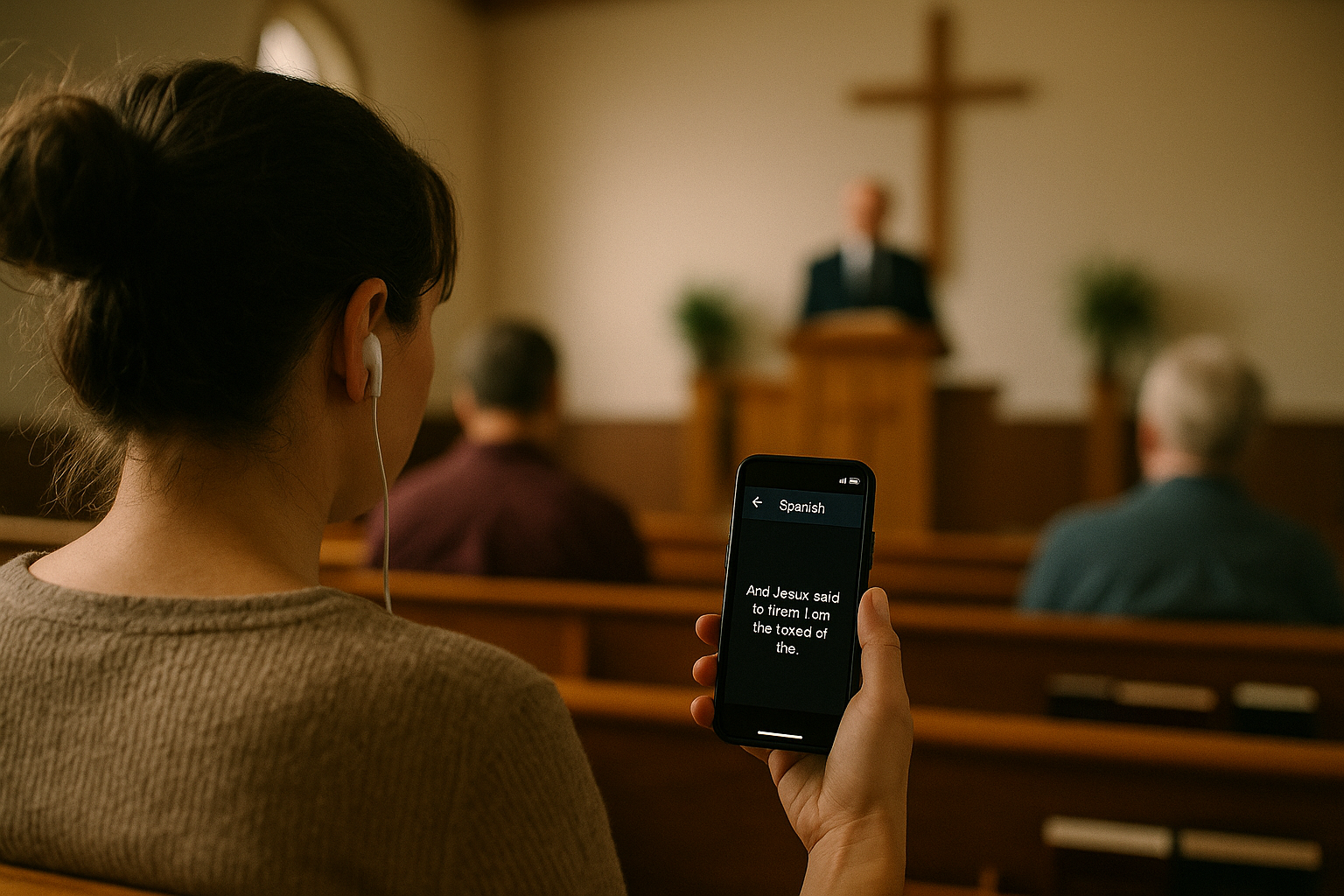
A translation app for church turns a phone your visitor already carries into a personal interpretation receiver. The person speaking from the platform is picked up once, translated in real time, and delivered to each listener in the language they picked — through their own earbuds, at their seat, with no hardware to hand out and nothing to collect at the door.
That's the whole promise, and it's worth being precise about it because the phrase covers two very different things. Some tools translate text — sermon notes, slides, bulletins. What most churches actually need is live interpretation: real-time spoken translation delivered to attendees' phones while the service is happening. If your Spanish-speaking families are currently missing half the sermon, a translated PDF next Tuesday doesn't fix that.
The payoff, when it works, is small and quiet: a family sits together in the main service instead of splitting off into a separate room, and nobody has to be singled out.
The three ways churches solve this — and the honest tradeoffs
Before you compare apps, get clear on which model you're buying into. Most congregations land in one of three places.
1. FM/IR headsets with a live human interpreter
The traditional setup: an interpreter in a booth or back row, transmitting to receivers you distribute before the service.
- Strengths: highest quality when the interpreter knows your church. Handles theology, humor, inside references, and the pastor's cadence.
- Costs: hardware to buy, batteries to charge, receivers to sanitize and track, and — the real constraint — a volunteer who must show up every single week. One language per interpreter.
- Best for: churches with a genuinely bilingual congregation and a reliable interpreting team already in place.
2. A phone-based app with human interpreters
Same human interpreter, but the audio routes through an app to attendees' phones instead of dedicated receivers. You lose the hardware headaches and gain unlimited "receivers" — everyone brings their own.
- Watch for: your WiFi. This model lives or dies on the guest network holding up when 60 people stream simultaneously.
- Best for: churches that already have interpreters but are tired of managing a bin of receivers.
3. AI live interpretation
Speech recognition transcribes the speaker, machine translation converts it, and attendees read captions or hear a synthesized voice. Several vendors now build specifically for congregations — LiveVoice, OneAccord, Aurelo, and ChurchTranslation.org among them, alongside general-purpose desktop tools that churches adapt for the same job.
- Strengths: covers many languages at once, runs every week without a volunteer schedule, scales to whoever walks in the door.
- Tradeoffs: it will not catch every idiom, and it doesn't know that "Pastor Dave" isn't a verb until you teach it. Quality on scripture references and proper nouns is the honest weak spot.
- Best for: churches with several small language groups, or one language group and no interpreter.
Many churches end up mixing: a human interpreter for the primary second language, AI for everything else. If you're weighing structural options beyond tech, our breakdown of how bilingual churches actually work covers the models behind these choices.
What to check before you commit
Feature lists blur together fast. These are the things that decide whether your app survives its third Sunday.
How languages are counted
"100+ languages" usually means the translation engine supports them. That's not the same as simultaneous output. Ask directly: how many languages can run at once, in one session, and does each one cost extra? A church with Spanish, Korean, and Portuguese speakers in the same room needs three concurrent streams, not a menu of a hundred you switch between.
Latency and the two-voices problem
There's always a delay between the pastor speaking and the translation arriving. A second or two is fine. Five seconds means your listener hears the punchline after the room has already laughed.
The related issue: if someone listens on one earbud, they hear the original voice in the room and the translation. Some people prefer that. Others find it unusable. Test with both earbuds in and one earbud out, and let attendees choose.
Church vocabulary
Ask whether you can supply a custom glossary — staff names, ministry names, book titles, your denomination's specific terms. A system that renders "Ephesians" as gibberish loses trust in one Sunday. Some platforms let you preload a term list; that single feature does more for perceived quality than any latency improvement.
Joining friction
Count the taps between a visitor sitting down and hearing translation. A QR code on the bulletin that opens a browser page — no app store, no account, no password — is the gold standard. If it requires a download, expect a large share of first-time guests to give up. Accessibility matters here too: captions serve deaf and hard-of-hearing attendees at the same time, which is why some vendors frame this as an ADA-adjacent accessibility tool rather than purely a language feature.
A realistic first Sunday
Here's a rollout that doesn't blow up in front of the congregation.
We walk through the wiring, microphone placement, and failure modes in more detail in our church translation app setup guide.
Budgeting without surprises
Pricing models vary widely across vendors, so compare on structure, not just headline numbers. The three common shapes:
- Per-minute or per-hour of translated audio — predictable for a church with one 75-minute service, less so if you add midweek groups and a Saturday night service.
- Per listener or per concurrent connection — cheap at ten listeners, expensive if the ministry grows, which is the outcome you're hoping for.
- Flat monthly subscription — easiest to put in a budget line, but check what's capped.
Ask what happens when you exceed the plan mid-service. Does it stop, or does it keep running and bill you? Also ask about a second campus, guest speakers, and whether recorded sessions count against your allowance.
Compare that against the true cost of the alternative: receivers, batteries, replacement units, and the volunteer hours spent handing them out. Hardware isn't free just because you already own it.
Try it on your own audio before you decide
No demo video tells you what a translation app for church will do with your pastor's accent, your room, and your sound board. The only useful test is your own service.
Run a single Sunday. Sit in the back with one earbud, follow the translation, and notice where it drops. Then ask two people who need it whether they'd use it again. That answer matters more than any feature comparison.
If you're ready to test, TransLync is built for exactly this — live interpretation for churches with attendees joining from their phones. Try 30 free minutes of live translation on a real service and judge it on your own audio. If you're also running conferences or a multi-day event, the same approach applies with more speakers and more rooms — see our conference translation breakdown.
Frequently Asked Questions
Do attendees need to download an app?
It depends on the platform. The lowest-friction option is a browser-based link opened from a QR code — no download, no account. If a tool requires an app store install, expect a meaningful drop-off among first-time guests, especially older attendees. Ask vendors this before you compare anything else.
Can a translation app replace our human interpreter?
For some churches, yes; for others, no. AI handles many languages at once and never misses a Sunday, but it struggles with idiom, humor, and scripture references unless you preload a glossary. A common middle path is keeping a human interpreter for your primary second language and using the app for smaller language groups.
What internet connection do we need?
Every listener streams over your guest WiFi or their cellular data, so bandwidth scales with attendance. Test with ten simultaneous connections before launch. If your guest network is already strained on Sunday morning, fix that first — it's the single most common cause of a failed rollout.
How accurate is AI translation for sermons?
Good enough for a listener to follow the message, but not word-perfect. Accuracy drops on proper nouns, denominational vocabulary, and fast or heavily accented speech. Clean audio from the sound board and a custom glossary of names and terms make the biggest difference.
Will it work for our midweek groups and Bible studies?
Usually yes, and small rooms often work better because the audio is cleaner. The thing to check is your pricing plan — per-minute models add up quickly once you're translating several gatherings a week, so confirm what's included before expanding beyond Sunday.
Sources
- LiveVoice: Live translation for churches
- Church Translation - Live AI Translation for Churches | OneAccord
- Live Translation for Churches, Live Audioübertragung für Kirchen. Best Price.
- Church Translation Software & System | Real-Time AI for Church Services | Aurelo
- Church Translation App for Churches: Easy, ADA-Compliant · Live Caption AI
- RiseCC Language Interpreter
- apps.apple.com
- Best Desktop Tools to Get Live AI Translations for Churches